
What is It?
Ever since it first appeared on the Road Map, the 26mm f/2.8 engendered a great deal of speculation. It still does so, well after it began shipping.
The question that has people scratching their heads is why Nikon would produce a 26mm f/2.8 pancake when they already had a 28mm f/2.8 muffin (for more on lens naming, see this article). Note that the “pancake” nature of the 26mm starts to disappear when you use the lens hood (more on that in a bit), so the head-scratching gets more intense.
A couple of things come to mind in evaluating the “why” of the 26mm f/2.8 lens. First, Nikon has a long history of creating Nikkor lenses that are unique in some way. The 26mm f/2.8 is unique in a couple of ways: the entire set of lens elements moves together for focus, and the optical design is a bit on the unusual side, with an eccentric set of rear elements.
So let’s start with that. I’ve written before that the Z-mount allows for some different approaches to lens design that couldn’t really be done in the old F-mount. The 26mm f/2.8 is a simple construct of 8 elements in 6 groups, but the three aft elements are very large, and the rearmost is the largest and is also highly and unusually curved. So much so that the center of that back element is almost sticking out of the rear of the lens. This lens has an extremely short and aggressive back focus. This is not an optical approach we’ve seen Nikon use much before, and it’s highly exaggerated in this lens. Three of the eight elements are also aspherical. There’s a strong sense from the optical design that this was a push by Nikon to experiment more dramatically with a new optical formula in their new mount.
Minimum aperture is f/16, and the aperture diaphragm uses a 7-blade rounded design. Up to almost minimum aperture, the diaphragm actually stays reasonably circular for a change. However, at f/16 on my sample, the top blade conjunction starts to form a point, a classic issue I’ve had with previous Nikon aperture rings.
While the lens uses the usual stepper motor for focus, that motor is driving a barrel containing the entire set of optical elements. This inner barrel comes fully out to the frontmost edge of the lens housing as it focuses. I judge that the lens elements are all making about 1/4” (6mm) of travel. The supplied HB-111 lens hood sticks out a teeny weeny bit more than the lens barrel will, which completely masks the focus movement from view from most angles. Minimum focus is 8" (.2m), which only produces a 1:5 magnification. This isn’t particularly a lens for close focus work, though I do note that you can focus a bit closer manually (0.18m).
Looking at the 26mm f/2.8 lens physically, it initially appears to be half the size of the 28mm f/2.8 in length (0.9”, or 24mm), but the same diameter (2.8”, or 70mm). On a Z5/Z6/Z7/Z8/Z9 body, the lens alone does not extend past the front of the hand grip (it does on a Zf ;~). However, when you add the supplied lens hood, you lose some of that shortness advantage compared to the muffins, and the lens does now extend just beyond the hand grip.
At 4.3 ounces (122g), the 26mm f/2.8 is the lightest Z-mount Nikkor yet, and by a significant margin.
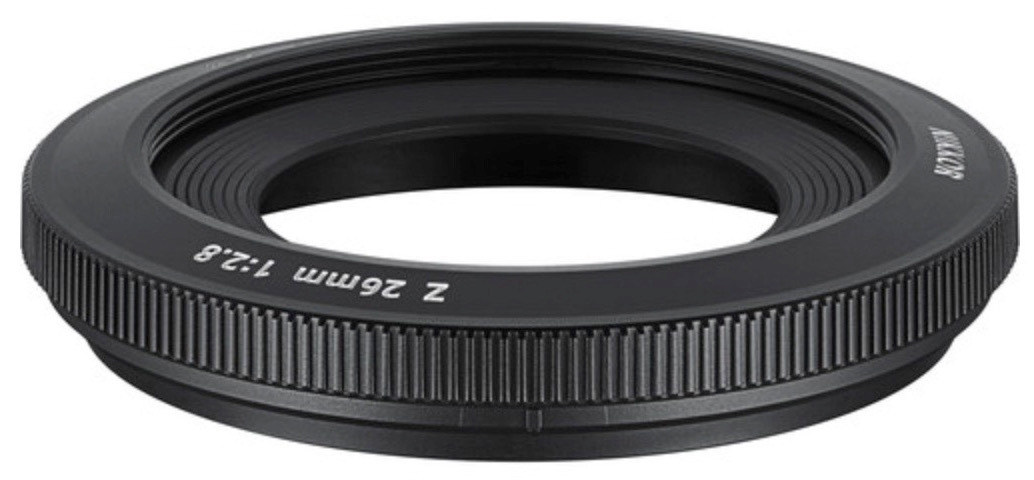
The toilet bowl lens hood.
The HB-111 hood itself is strange (image of it, above). It looks like another “ring” when mounted to the front of the lens. You should be using the hood with this lens due to the front element extending forward at certain focus distances; the optical barrel moves within the “hood ring” during focus and stays protected with the hood on. The hood does not move while the lens focuses. The hood is also where you attach 52mm filters, if needed. No filter ring exists on the lens itself!
The lens cap for the 26mm f/2.8 is also different. Instead of the usual pinch-style front cap, the 26mm f/2.8 comes with a slip-over cap. This cap slips over the lens hood, or the lens itself without the hood mounted. The cap has a felt liner that engages the ribs on the lens hood (or lens focus ring without hood). While this seems more secure than previous similar designs Nikon has used, I'm not sure how it will hold up. Moreover, you need to make sure you're not getting sand and dirt in the felt itself.
The 26mm f/2.8 is made in Thailand (the inscription is within the rear shell). It sells for US$500. Nikon marketing’s shorthand for the lens is “pocket prime."
Source of the reviewed lens: purchased
How’s it Handle?
Note that the lens hood only locks in position when you install it correctly (Nikkor name up). Other positions are possible, but they’re not locked, and you’re going to find that the hood then falls off during use. Moreover, it takes a hard twist to make the hood lock onto the lens. Start with the “Nikkor” on the hood at the 9 o’clock position (facing the front of the lens) and twist it clockwise to mount, but make sure you feel that distinct lock click at 12 o’clock; without that locking click, again, the hood will soon fall off.
With the hood securely mounted, you end up with two “rings” that feel very similar due to the texture put on the hood for mounting/removal and holding the lens cap, but only one of these textured areas—the one closest to the camera—is an active ring. I’d say that Nikon needs to do a bit of rethinking here, as I find the hood design slightly problematic.
The 26mm f/2.8 does support the Focus ring rotation range on cameras that have that ability, which coupled with the firmware updates we’ve seen to date seems to suggest that eventually all Z-mount Nikkors will eventually have that ability.
How’s it Perform?
Focus: While focus performance is fast, you need to know about three focus performance aspects of this lens: (1) focus moves are anything but silent and chatter much more and more loudly than any other Z-mount lenses; (2) the 26mm f/2.8 lens has a great deal of focus breathing (over 10% in a full focus pull); and (3) there's a small amount of focus shift that will require you to be careful using apertures above f/5.6. These bits are unlike any previous Z-mount prime Nikkor we’ve seen: the focus breathing is easily enough to be seen in almost any video focus pull, even modest focus distance changes. The lens noise and chatter isn’t annoying to me, but it is more than enough to get recorded in videos and heard in quiet venues.
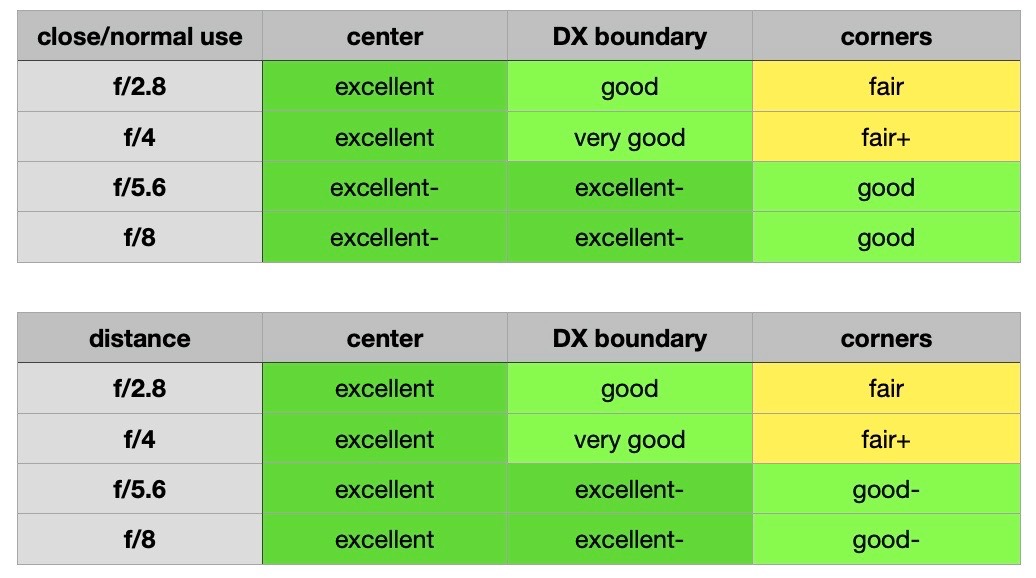
Sharpness: Let’s start with using the lens at distance. The lens is excellent wide open at center. As you move significantly outwards you’ll see a coma-caused blur and a clear loss of contrast; I’d judge the extreme corners to be no more than fair wide open. Stopping down one stop helps the center a tiny bit and brings much more of the lens area up to excellent, with the corners now fair+ and recovering contrast. The absolute corners never “snap” into acuity, though, while the DX frame tends to stay in the good-to-excellent range through the usual apertures I test (I don’t test above f/11 due to diffraction impacts).
Up close I was surprised to find that the lens is about the same. Center sharpness is again excellent wide open, with corner sharpness being no higher than fair. The center does lose a little of its punch as you stop down, but the DX corners come up to good level by f/5.6. You really have to stop down to f/11 to pull the majority of the frame into very good+ (the center slumps some and the DX corners come up, while the far corners gain contrast but still aren’t above good-).
Once again the absolute corners at both distances are clearly slightly blurred, even at the best overall aperture (f/5.6). I’d judge the corners are going soft due to some very minor field curvature coupled with what is clear coma. The 26mm f/2.8 has some of the most obvious coma in the corners I’ve seen in the Z-mount, and you really have to stop down to f/5.6 to remove the most obnoxious elements of it. Interestingly, the coma really is mostly limited to the FX corners; from the DX to FX corner the coma seems to exponentially expand. Spherical aberration and astigmatism is low, though.
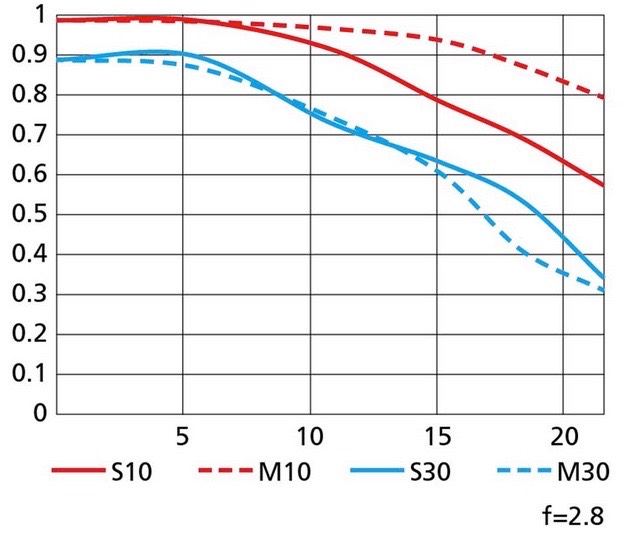
Nikon's own published (theoretical) MTF shows the center to edge degradation fairly clearly (DX boundary is at 16 on the horizontal axis.
How’s all this compare to the 28mm f/2.8? Despite the extreme corner letdown, the 26mm f/2.8 is better for most uses, basically. I’d tend to pick the 26mm over the 28mm at virtually all apertures, though at f/5.6 a DX user might not see much difference (the FX user will see the change in the borders and corners, where the 28mm stopped down enough will eventually trump the 26mm, but the center won't be as good). The 26mm f/2.8 may even be a bit better through the DX corners than the 24-70mm f/4 at 26mm. That’s true both wide open and stopped down.
Characterizing this lens is a bit difficult because out through the DX corners it's far better than expected, particularly for its price. But some of you will want the corners to be better than they are.
Chromatic Aberration: Lateral CA really doesn’t seem to be in play; the lens is well corrected for that. Longitudinal CA is present at f/2.8 but quickly corrects as you stop down (mostly gone by f/5.6). Longitudinal CA does show up in the bokeh.
Vignetting: Corner dimming is clearly a concern wide open with more than a 2.5EV difference from the center, though it begins to be fixed by f/4, and gets below 2EV at f/5.6. The vignette circle starts to show just inside the DX corners and is high enough outwards of that so that the left and right FX frame edge have heavy vignetting, not just the extreme corners. It does not appear that Nikon has supplied the correct lens correction information, though. Vignetting correction done in camera still triggers a large amount of vignetting.
Linear Distortion: Clear barrel distortion is present at about 2% with DX, and 5% with FX, and this has a tiny bit of a mustache to it. The in-camera corrections do a decent job of fixing it, but are not perfect and perhaps add a bit of corner softness.
Flare: You can provoke the lens to produce a prism like ghost with an in-frame light source, though that ghost tends to stay close to the source. Veiling flare, on the other hand, is not really a trait of this lens. Blacks stay black, even near an in-frame light source. This lack of significant veiling flare, coupled with the strong optical performance in the DX frame is a strength of this lens, and makes centered or near centered subjects pop more than they do on the 28mm f/2.8.
Bokeh: You’ll see a bit of cats eye as you move from the center of the frame, and that’s made significantly worse by a bit of additional clipping as you near the corners. Longitudinal CA on the blur spheres produces slightly different colored rims in the front and back out of focus area, particularly wide open. Onion rings are present but not as regular as I’m used to; the absolute center of the blur doesn’t show much ringing, nor does the outmost area just before the rim, but in between the onion-skinning is heavy and obvious. The blur behind the focus point seems to be the softer sort preferred by bokehphiles. Still, I don’t think this is a lens I’d pick for its bokeh.
Final Words
This is a tough lens to recommend. It’s an odd focal length, it handles a bit oddly, it’s not silent, it focus breaths, and it’s higher priced than the other small Nikkor primes. What was Nikon thinking? On the flip side, it’s ridiculously small and performs much better than you might expect, with a really strong central region with almost no optical issues. Oh, that's what they were thinking. Unfortunately, it’s tough to say who this lens is really designed for.
On a Z9, the lens is so small and light by comparison as to almost be considered as an optically-enabled lens cap. On a Z5, Z6, Z7, or Z8 the lens is small enough to fit in most body-only cases, as the lens doesn’t stick out past the grip. Indeed, the 26mm f/2.8 on a Z5/Z6/Z7 produces something akin to a jacket-pocket camera (large pockets, though). Thus, one possible use of the lens is to have a travel-friendly option that’s always ready on the camera.
Nikon makes a point of saying that 26mm is a smartphone-like focal length. With the 11 model, iPhone’s started using a 26mm (equivalent) lens as their main focal length (true of iPhone 11 through 17, though the Pro models have moved to 24mm. The problem I have is that I’m certainly not using my Z9 as a smartphone substitute; even a Z5 need not apply for that role, in my opinion. Plus I don’t really see smartphone owners moving up to a full frame camera and wanting exactly the same angle of view with a noisy lens.
If you use the 26mm f/2.8 on a DX camera, you’re at 39mm effective, and with excellent optical performance from f/4 onwards (the corners are a bit soft wide open, and vignetting will also still be slightly visible at f/2.8). I prefer the 26mm to the 28mm on DX, but neither would be an effective focal range I personally use much.
Overall, your decision about this lens isn’t going to be so much about it’s ability, but more about whether you like the focal length and the really small package. Thus, I have to say that my recommendation is conditional.
Recommended (conditional) (2023 to present)