
What is It?
The 24mm f/1.7 DX is the first prime in Nikon’s DX lens lineup. It functions much like a 35mm lens does on FX (full frame). That focal length is not highly wide angle, but nor is it “normal”, either. It’s a focal length that has traditionally been used for street and event photography, as well as some casual travel and landscape work.
The lens is small(ish): the 1.6” (40mm) depth doesn’t stick out much beyond the front grip of a Z30 or Z50, and at 4.8 ounces (135g) is about as light as a lens gets these days. However, note that the supplied HB-42 lens hood extends the front of the lens almost another inch.
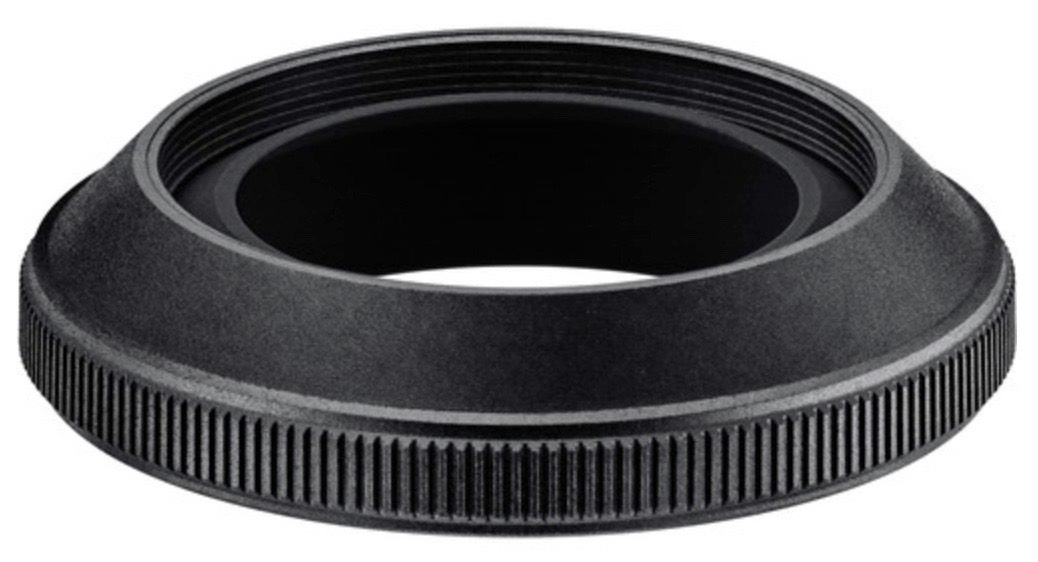
That lens hood (above) screws into the 46mm filter threads on the front of the camera and is what I call an inverse funnel hood (front smaller than back). The front lens cap (or filters) can be used either on the 24mm f/1.7 DX without the hood, or attached to the front of the hood. It’s an odd design for no clear reason. Generally a funnel hood is used when the front elements move forward during focus, but that’s not the case on this internal focusing lens.
Focus is as close as 7” (0.18m), which provides a maximum magnification of just over 1:5. Not a macro lens, for sure, but the 1:4 and 1:5 range is where I generally want a non-macro to be, as it allows for some closer work.
The optical formula is a simple 9 elements in 8 groups, with two of the rearmost elements being aspherical. The aperture diaphragm is 7 rounded blades, and the minimum aperture is a slightly restrictive f/11. I use the word “restrictive” because in bright light and certain shutter/ISO settings, you might find yourself hitting the shutter speed limit with no ability to pull it back by using a smaller aperture.
As usual with the DX lenses, the build and mount is plastic, although Nikon does claim that it has weather sealing (but also uses overlap rather than a rubber gasket at the lens mount itself).
The 24mm f/1.7 DX is made in China, and lists for US$280.
Source of reviewed lens: purchased.
How’s it Handle?
Aside from the odd lens hood, there’s not really anything to say. The lens hood has ribbing that by feel seems like it should be a control ring, but is really only there to help you unscrew it from the lens.
How’s it Perform?
Focus: Actual focus change is quick, as you’d expect from a simple lens with a stepper driving only a couple of elements. However, despite what Nikon says about focus breathing (“minimized”), video users should know that there’s significant and visible focus breathing.
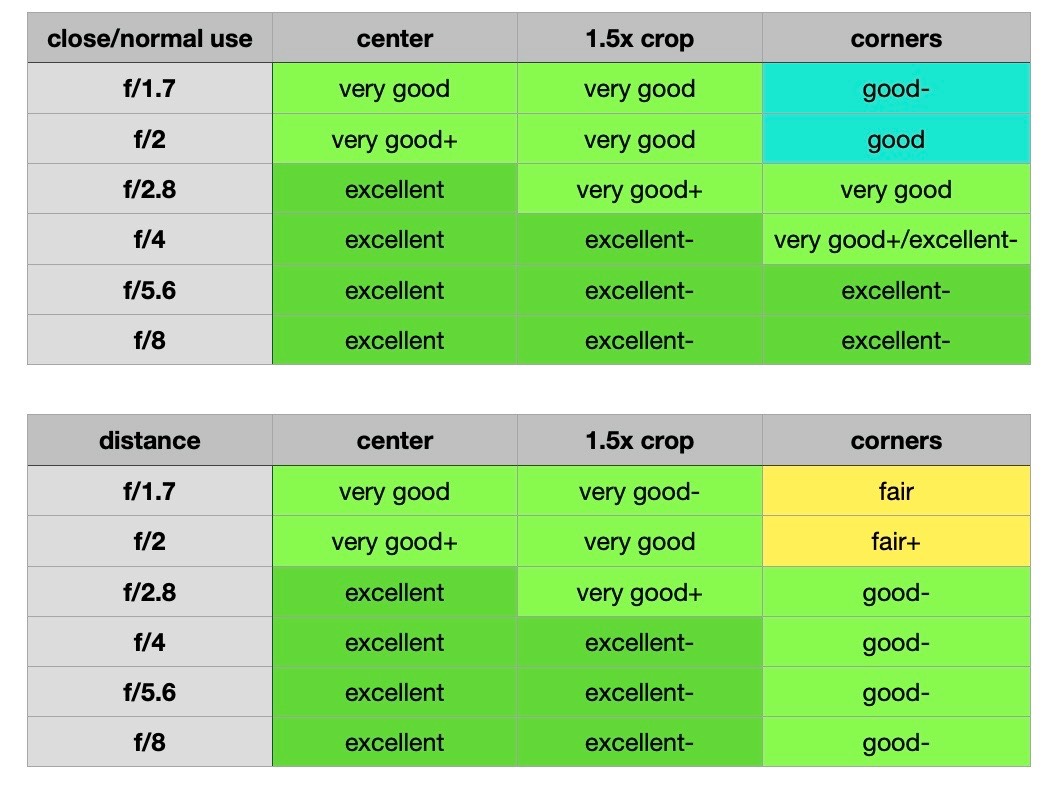
Sharpness: At test chart (and more normal use) distances the center is very good wide open and improves to excellent by f/2.8. The corners are good- wide open and require f/4 to get to very good+/excellent- (right on my border between the two). Some might not find the wide open corners to be an issue, as they disguise moire and other issues on fine detail without reducing the overall contrast as much as you might expect. Still, if you’re operating at closer distances with the lens, you really want to be at f/2.8 or smaller for good edge to edge results, and f/4 if you can get there.
At distance the center is still very good wide open. What changes some is that the corners fare a bit worse than expected, and having so much vignetting is also going to bring noise into the equation if you correct them. I’d judge the distance corners to be no better than fair wide open, and they never really get any really usable acuity as you stop down. However, note I wrote “corners.” At a bit beyond the 1.5x crop line, I’d judge the lens to be about the same at distance as it is closer up. Some of the difference has to do with a small bit of field curvature. Thus, it’s truly the extreme corners that start to become a problem at distance. But then again, I’m not sure why you’re using a 24mm f/1.7 prime for distance work. You have better options available in the zoom lenses already.
Spherical aberration and coma seem relatively suppressed on this lens, however the field curvature issue makes it not exactly one you’d want to use for astrophotography work (and is probably the real issue with the corners at distance). Indeed, coma is actually quite well handled for a lens at this price, however there’s some astigmatism that seems to increase as you stop down.
Chromatic Aberration: As you’d expect from a fast prime, longitudinal CA is clearly present wide open, with a green front and magenta back balance. It’s not as bad as I would expect for f/1.7, but it’s clearly present, and you’ll probably see it on high contrast edges. Lateral CA is essentially ignorable.
Vignetting: Strong corner vignetting at f/1.7, which can be over 2 stops. The vignette circle is clearly apparent, too: the top and bottom of the image area show little, but the left and right long axis edges show almost as much as the corners. You get a clear spherical presentation of vignetting wide open. This is worse as the lens focuses at distance than it is when focused at the closest focus distance, where the circle has expanded so that the left/right edges on the long axis have little vignetting.
Linear Distortion: Well corrected by camera corrections, there’s a small level (1%+) of pincushion distortion on uncorrected images.
Flare: Nothing particular to write about. You can provoke faint colored ghosts with in-frame or frame-edge light sources, but the amount is modest and singular in color (easier to correct). The flare appears to be partially aperture position related, as you can clearly see the diaphragm pattern when stopped down.
Bokeh: A fairly bright edge ring with longitudinal CA colors, but mostly well controlled internal aberration rings. Surprisingly modest cats eye, and for once, a lower cost Nikon’s aperture blades didn’t seem particularly out of symmetry. This lens’s bokeh character exceeds my expectations. Reasonably pleasing out of focus areas are easily obtained.
Final Words
It’s interesting that Nikon chose the 24mm focal length for their first Z DX prime when they instead chose 35mm for their first DSLR DX prime. This might be because of the already available 28mm and 40mm FX primes that are also appropriately sized for DX. Still, we have a gap in between at 33/35mm that some might want filled [finally filled with the 35mm f/1.7 DX]. Moreover, we never got truly wide angle primes for DSLR DX, and so far it’s looking like Nikon thinks the same for Z DX.
That’s a shame, because I’m sure those vlogging creators Nikon is seeking with the Z30 and Zfc would certainly want wider small primes, and Sony already has several that work with their APS-C cameras. If you do need wider, you have the choice of the Viltrox 9mm f/2.8 Air or 13mm f/1.4, and the Sigma 16mm f/1.4, but two of those are physically larger lenses than what seems proportional to the current DX bodies.
Overall, the 24mm f/1.7 DX is a very good lens, particularly for close-to-mid distances as opposed to infinity distances. Unfortunately, it’s not quite strong enough a performer for me to give it a straight out recommendation. If you’re looking for a mild wide, moderately fast prime for events, street, and travel photography, you’re likely to enjoy this lens, and it certainly keeps your kit small and light. If you are looking for a prime that knocks your socks off with its acuity, then Luke, this isn’t the lens you’re looking for.